

『Doppler Flow Meter Working Principle: Frequency Shift Off Particle Slurry Physics』Related information(flow rotameter|digital flow meter|balo meter|hydraulic flow meter|volumetric meter|positive displacement meter|pitot tube flow meter|displacement meter|cfm meter|variable area flow meter|inline flow meter|differential pressure flow meter|calibrated flow meter|velocity meter|paddle wheel flow meter|oval gear flow meter|anemometer hvac|multiphase flow meter|doppler flow meter|thorpe tube flowmeter|heat flow meter)
Doppler Flow Meter Working Principle: Frequency Shift Off Particle Slurry Physics
Quick Answer: A Doppler flow meter reads frequency shift off particle slurry physics. The meter sends an ultrasonic wave into a slurry and receives a shifted frequency from moving particles or bubbles. Silver Automation Instruments converts that frequency shift into velocity and flow rate for dirty, high solid, and abrasive fluids.
What the Doppler Flow Meter Really Measures
A Doppler flow meter does not measure clean water velocity as a primary target. It measures the movement of reflectors inside the fluid. The sensor contains a piezoelectric crystal. The crystal transmits a continuous ultrasonic signal at 640 kHz or 1 MHz through the pipe wall. The signal hits particles, fibers, or bubbles in the fluid. A small part of that sound bounces back to a second crystal. If the fluid is moving, the returned signal has a different frequency. The transmitter reads that frequency shift and converts it to flow velocity.
How Frequency Shift Works in Slurry Physics
Think of a moving train horn. The sound pitch changes as the train passes. That is the Doppler effect. In a pipe, moving particles act like the train. The frequency shift depends on the transmitted frequency, the flow velocity, the sound speed in the fluid, and the sensor angle. For a 640 kHz sensor on a DN150 slurry pipe, a 2.0 m/s flow may create a frequency shift of several hundred Hertz. The meter calculates flow rate from that shift and the pipe internal diameter. The installer must enter the correct pipe size into the transmitter.
Particles and Bubbles Are Not Optional
Doppler flow meters need discontinuities in the fluid. We call them reflectors. In practical terms, the fluid should have at least 2 percent suspended solids by volume or about 100 ppm air bubbles. Particle size above 100 micron is typical for a stable signal. Clean water with no bubbles gives a weak or absent reading. A drilling contractor in Western Australia once used a Doppler meter on clean groundwater. The reading jumped between zero and full scale. The solution was to monitor a bentonite mud line instead, where the solids content stayed above 5 percent.
Where Doppler Flow Meters Perform Best
Doppler meters work on dirty, abrasive, and settling fluids that damage internal flow meters. Common applications include dredge slurry, mine tailings, paper stock, activated sludge, lime slurry, and industrial wastewater. A dredging contractor in Singapore uses a Silver Instruments clamp on Doppler meter on a DN300 HDPE pipe. The fluid is a sand and water mixture with 12 percent solids. The meter sends a 4 to 20 mA HART signal to a dredge control panel. No internal electrodes or moving parts touch the slurry.
Installation Notes from Customer Sites
Mount the sensor on a straight pipe run. Provide at least 10 pipe diameters upstream and 5 pipe diameters downstream. On horizontal pipes, place the sensors at the 3 o clock or 9 o clock position. Top mounting catches air pockets. Bottom mounting catches settled solids. Both reduce signal quality. Clean the pipe surface before moun
Model Selection and Output Signals
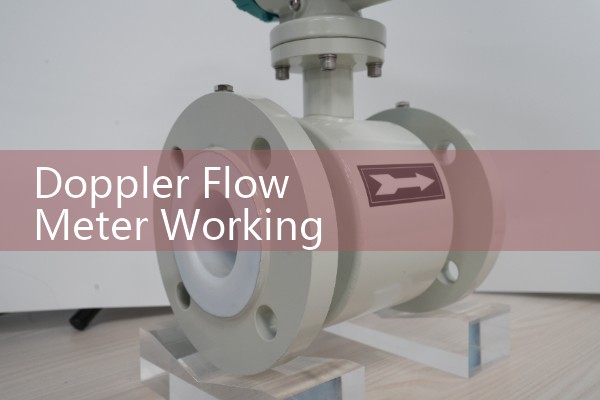
For DN25 to DN400 slurry lines, Silver Instruments often quotes the DFM200 clamp on Doppler flow meter. The transmitter accepts pipe sizes from 25 mm to 400 mm. It outputs 4 to 20 mA HART, open collector pulse, and RS485 Modbus RTU. Accuracy is about 2 percent of reading when solids content stays above 2 percent. The enclosure is IP66. Power options are 24 VDC or 220 VAC. Pipe materials include carbon steel, PVC, HDPE, and cast iron. Fluid temperature range is from minus 20 to 80 degrees Celsius.
Common Mistakes We See in the Field
Most engineers skip one small step. They enter the pipe inner diameter incorrectly. The flow rate is velocity times cross sectional area. A 5 mm error on a DN80 pipe changes the flow reading by more than 10 percent. Some users install the sensor on a vertical downpipe with air slugs. That creates unstable readings. Place the sensor in a vertical upward line if possible. The liquid should fill the pipe completely. Do not use Doppler meters on clear chemicals like methanol or deionized water unless you inject fine bubbles downstream.
How to Request a Doppler Flow Meter Quote
Tell us your pipe size DN, pipe material, solid content percentage, flow range in cubic meters per hour, fluid temperature, and output signal. We will recommend a Doppler flow meter and send price, lead time, and freight cost. Email or call Silver Automation Instruments. Tel: +86-25-68650347. WhatsApp: +86-25-52155837. WeChat: +86 15365082610. We supply industrial flow instruments to Southeast Asia, Oceania, Latin America, Africa, and the Middle East.
FAQ
Q: What is the main difference between a Doppler flow meter and a transit time ultrasonic flow meter?
A: A Doppler meter needs particles or bubbles to reflect the signal. A transit time meter needs a clean liquid with low solids. Slurry and sludge usually require Doppler. Clean water and chemicals usually require transit time or electromagnetic.
Q: Does a Doppler flow meter work on clean water?
A: No, not reliably. Clean water lacks reflectors. You need at least 2 percent solids or 100 ppm bubbles. Use an electromagnetic or transit time meter for clean water.
Q: Can Doppler measure mining slurry with high solids?
A: Yes. Doppler works well on tailings, dredge slurry, and paper stock. The meter handles solids content from 2 percent to about 60 percent depending on pipe size and signal strength.
Q: How do you install a Doppler flow meter on a pipe?
A: Clean the pipe surface. Apply couplant. Strap or clamp the sensors at the 3 o clock or 9 o clock position on a horizontal pipe. Provide 10D upstream and 5D downstream straight run.
Q: What output signals does a Doppler flow meter provide?
A: Silver Instruments Doppler meters provide 4 to 20 mA HART, pulse, and RS485 Modbus RTU. You can send flow data to PLC or SCADA systems.
 Hot News
 Related AD